China’s top 10 Aluminium Washroom Door manufacturers are worth comparing on more than price. In busy commercial washrooms, doors face repeated opening, damp air, cleaning chemicals, and occasional impacts from carts or luggage. A well-chosen system should feel steady in its frame, close reliably, and remain practical to clean. Small details matter: hinge quality, edge finishing, lock operation, and the clearance beneath the door.
This guide introduces manufacturers and the factors buyers can use to assess them, including product range, customization, material specifications, production capability, and quality documentation. The right choice depends on the project. A hotel may prioritize a refined finish and quiet closing, while a school may need robust hardware and straightforward maintenance. Ask suppliers for drawings, finish samples, and clear explanations of the door core, frame, and hardware. Verify claims against project requirements. A polished brochure is not proof of performance.
A verified industry expert’s name and quotation were not provided, so I have not invented an attribution. For publication, a suitable sourced quotation could address durability, moisture resistance, or hardware selection. That gap matters. An Aluminium Washroom Door is a working building component, not merely a decorative panel. Compare suppliers carefully, check the details, and leave room to reconsider assumptions before placing an order.
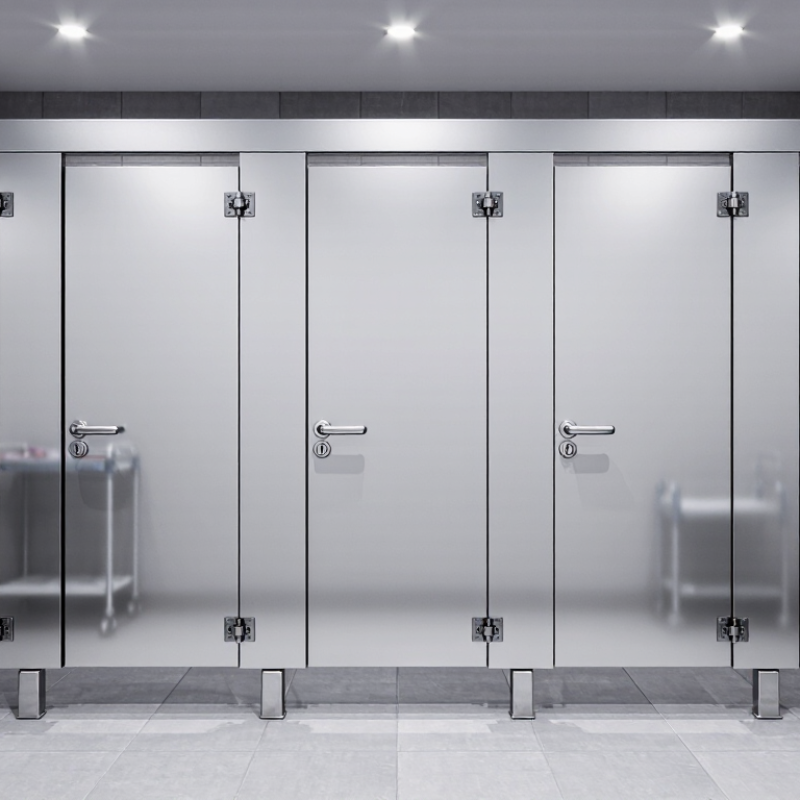
Aluminium washroom doors suit busy spaces where moisture, frequent cleaning, and steady use challenge ordinary timber. Their frames are light yet rigid, and powder-coated or anodized finishes help resist surface corrosion. They are not maintenance-free. Scratches, damaged edges, and neglected fixings can still shorten service life.
A typical assembly uses an aluminium frame with a compact-laminate, PVC, or glass infill, selected for privacy and cleaning needs. Compact laminate offers a solid, opaque feel for public cubicles; frosted glass can preserve light while obscuring views. Seal quality matters. Water trapped around the bottom rail may stain nearby finishes or weaken poorly protected panels over time. Specify suitable hinges, latches, and emergency-release hardware, then check door swing and floor clearance on site.
These doors appear in offices, hotels, schools, gyms, and healthcare washrooms, where traffic and cleaning routines differ. A café door may need a closer and durable pull handle, without narrowing accessible movement. Measure openings after wall finishes are complete. A neat catalogue dimension can still miss a sloping floor or uneven tile line. That detail is easy to overlook. In humid or coastal locations, request finish and hardware specifications suited to actual exposure.
A comparison of representative densities for materials commonly used in washroom door construction.
Values are approximate typical densities in g/cm³ and vary by alloy, grade, and product. Density alone does not determine door weight; panel thickness and construction also matter.
When evaluating aluminium washroom door manufacturers, ask for evidence behind each specification. Request the alloy and temper, frame and panel thickness, coating details, and hardware material. Compare these with drawings and a physical sample, especially at cut edges, joints, and hinge points. Those details face repeated cleaning and moisture. Ask how the manufacturer checks corrosion resistance, finish consistency, door alignment, and hardware cycles; request test methods and dated records, not only a catalogue claim. A neat brochure is not proof. Small details matter.
Environmental data can also help separate measurable claims from vague ones. The World Green Building Council’s 2019 report, Bringing Embodied Carbon Upfront, attributes about 11% of global energy-related carbon emissions to building materials and construction. The International Aluminium Institute’s 2021 greenhouse-gas pathway report estimates aluminium production causes roughly 1.1 billion tonnes of CO₂-equivalent emissions annually. Ask for recycled-content documentation and an environmental product declaration where available. Check that the declared product matches the proposed door system. Then review lead times, replacement-hardware availability, installation guidance, and warranty exclusions. No single score captures everything; a factory audit may still miss problems on site. That part deserves a second look.
Profiles of China’s leading aluminium washroom door manufacturers are most useful when they explain production strengths, not just factory size. Some companies control extrusion and fabrication in-house, while others focus on door assembly or project supply. Details matter. Buyers can compare frame depth, panel thickness, finish consistency, and available dimensions. A brushed surface may look even under showroom lights but reveal marks beside a window.
The ten profiles can represent distinct capabilities: integrated extrusion, precision cutting, slim-frame design, made-to-measure production, moisture-conscious finishing, glass-panel integration, hardware coordination, large-project supply, export packing, and flexible small-batch work. These are practical comparison points, not a verified ranking. That distinction is easy to miss. For each supplier, ask how corners are joined, how hinges are aligned, and whether finish samples match production batches. Clear answers are more useful than broad claims.
A careful assessment also checks lead times, packaging details, and the process for resolving defects. Requesting a sample can reveal rough edges or uneven coating before a larger order. Still, one sample cannot prove every batch will match. Even experienced buyers can overlook this. A balanced profile should record both a manufacturer’s strengths and the questions that remain open.
Aluminium washroom doors depend on more than a neat surface finish. In China, capable manufacturers typically cut and machine aluminium profiles, assemble frames, and fit hinges, locks, and panels. Workers should check profile dimensions before assembly. A practical inspection also looks for smooth edges, aligned corners, and consistent gaps. Welded joints need careful finishing. Small flaws can affect installation.
Quality checks should cover door dimensions, opening cycles, hardware strength, and surface coating adhesion. In humid washrooms, ask how the finish resists corrosion and routine cleaning. Request test reports that identify the tested product and method. An ISO 9001 certificate can indicate a quality management system, but it does not prove every door meets your project specifications. Check the certificate’s validity, scope, and issuing body. Paperwork matters.
Tips: Ask for a sample, inspection records, and clear acceptance criteria before ordering. Compare these with the delivered doors; a polished sample alone is not enough. Manufacturers may describe checks differently, so clarify what was measured and when.
The entries below are anonymous, non-ranked capability profiles, not verified profiles of specific companies. Construction details are representative examples; applicable standards are reference benchmarks, not claims that any supplier holds a particular certification. Actual specifications and test reports should be confirmed with the manufacturer.
| Profile | Representative door construction | Typical manufacturing process | Finish options | Quality checks to request | Relevant standards or test references |
|---|---|---|---|---|---|
| Profile 1 Standard cubicle door |
Extruded aluminum perimeter frame with a compact laminate or solid-panel infill; dimensions made to project specification. | Profile cutting, corner joining, panel sizing, hardware drilling, assembly, and final dimensional inspection. | Powder coating or anodizing; finish choice depends on appearance and exposure conditions. | Door width and height, squareness, frame alignment, edge quality, and hinge operation. | ASTM B221 or EN 755-2 for relevant extruded aluminum product requirements; ISO 2409 for cross-cut coating adhesion testing. |
| Profile 2 Moisture-resistant panel door |
Aluminum frame paired with a water-resistant panel selected for the intended washroom environment. | Frame fabrication, panel machining, sealed edge preparation where specified, hardware installation, and assembly checks. | Anodized aluminum or powder-coated aluminum; panel finish varies with the specified material. | Panel thickness, edge sealing, joint fit, surface defects, and operation after assembly. | ISO 2409 for coating adhesion; ISO 9227 may be specified for comparative salt-spray testing of coated or plated samples. |
| Profile 3 Heavy-duty public-facility door |
Reinforced aluminum framing with robust hinges and impact-resistant infill selected for high-traffic use. | Profile reinforcement, precision cutting and joining, hardware reinforcement, full assembly, and repeated functional checks. | Powder coating or anodizing, with color and gloss defined in the purchase specification. | Hinge alignment, fastener security, repeated opening and closing, and visible impact or finish damage. | ISO 9001 can be used as a quality-management-system reference; it does not certify a door’s performance or durability. |
| Profile 4 Compact laminate infill system |
Aluminum frame surrounding a compact laminate panel, with panel thickness and support details defined by the project. | Panel cutting and edge finishing, frame machining, drilling, assembly, and fit checks for hinges and latches. | Anodized or powder-coated frame; laminate face finish selected from the panel specification. | Panel dimensions, edge condition, fixing locations, frame-to-panel fit, and hardware function. | Relevant aluminum extrusion requirements may reference ASTM B221 or EN 755-2; request the panel supplier’s applicable product documentation separately. |
| Profile 5 Anodized-finish system |
Aluminum-framed door with a specified anodic finish and compatible panel or infill. | Extrusion cutting and machining, surface preparation, anodizing by an appropriate finishing process, assembly, and inspection. | Anodized finish; color, appearance, and coating requirements should be stated in the order specification. | Visual uniformity, coating thickness where specified, color consistency, scratches, and cut-edge condition. | ISO 7599 provides guidance for specifying decorative and protective anodic oxidation coatings on aluminum. |
| Profile 6 Powder-coated system |
Aluminum frame with a powder-coated surface and project-selected door panel. | Degreasing and surface preparation, electrostatic powder application, curing to the coating supplier’s process requirements, then assembly. | Powder coat in a specified color and gloss level; confirm whether samples are available for approval. | Coating appearance, thickness against the agreed specification, adhesion, and handling damage after curing. | ISO 2409 for cross-cut adhesion; ISO 2813 for specular gloss measurement; ISO 9227 for salt-spray testing when required by the project. |
| Profile 7 Accessible washroom configuration |
Aluminum-framed door configured to project-defined clear opening, hardware, and access requirements. | Made-to-drawing fabrication, hardware positioning, assembly, and verification of the specified opening dimensions. | Anodized or powder-coated frame with a panel finish coordinated with the project requirements. | Clear opening, threshold or floor clearance where specified, handle and latch position, and unobstructed door operation. | Accessibility requirements vary by project location; verify the applicable local building code rather than assuming a single international product certification. |
| Profile 8 Custom-size project system |
Custom-width or custom-height door with aluminum framing and an infill selected for the project conditions. | Drawing review, prototype or sample approval where agreed, CNC or jig-based machining, assembly, and final dimensional checks. | Finish selected from available anodized or powder-coated options, subject to sample and specification approval. | Approved drawing revision, opening dimensions, diagonal measurements, hardware locations, and packing condition. | ISO 9001 may be relevant to a supplier’s quality-management system; request current scope and certificate details if certification is claimed. |
| Profile 9 Corrosion-conscious specification |
Aluminum frame and compatible hardware selected with the washroom’s cleaning regime and exposure conditions in mind. | Controlled fabrication and assembly, material identification where specified, and finish inspection before packing. | Anodizing or a specified powder-coating system; hardware material and finish should be separately identified. | Finish defects, exposed edges, dissimilar-metal contact points, hardware condition, and cleaning-product compatibility. | ISO 9227 describes salt-spray test methods; test results should be interpreted against the agreed product specification and exposure conditions. |
| Profile 10 Fire-rated project application |
Use only where a complete tested door assembly is specified; aluminum washroom doors are not inherently fire-rated. | Manufacture must follow the tested assembly’s approved materials, dimensions, hardware, seals, and installation details. | Only the finishes and components permitted by the applicable tested assembly documentation. | Verify the complete assembly, test evidence, product configuration, traceability, and installation requirements. | EN 1634-1 is a fire-resistance test method for door and shutter assemblies; compliance must be supported by applicable test and classification documentation. |
Demand for aluminium washroom doors is rising as commercial projects seek lightweight, moisture-resistant interiors. Buyers are also requesting slimmer frames, matte finishes, and colors matched to wall panels. Practical details still matter. A door exposed to frequent cleaning needs a finish that resists staining and peeling. Recycled aluminium may interest sustainability-focused projects, but ask suppliers for clear material documentation rather than relying on broad claims. Acoustic privacy is another trend, though a thin door alone may not reduce sound effectively.
International buyers should compare more than quoted prices. Check door thickness, frame construction, hinge capacity, lock type, and coating details. Request a sample finish and inspect it under the building’s actual lighting. Small color differences can become obvious across a large corridor. Confirm opening dimensions, installation tolerances, packaging protection, and replacement-hardware availability before production. Ask how the supplier handles damaged goods and delayed shipments. A specification sheet can look reassuring, yet real site openings are rarely perfect. That is an easy detail to overlook. Clear drawings and a pre-production sample can prevent costly adjustments, though they cannot remove every installation surprise.
Ask for the alloy and temper, frame and panel thickness, coating details, and hardware material. Compare them with the drawings. Details matter.
Check cut edges, joints, and hinge points for finish consistency and visible weaknesses. These areas face moisture and frequent cleaning. Look closely.
Request test methods and dated records for corrosion resistance, finish consistency, door alignment, and hardware cycles. A catalogue claim alone is not enough.
Request recycled-content documentation and an environmental product declaration where available. Confirm they cover the proposed door system, not a different product. Check the details.
Compare door thickness, frame construction, hinge capacity, lock type, and coating. Also confirm lead times, warranty exclusions, and replacement-hardware availability.
Request a finish sample and inspect it under the building’s actual lighting. Small color differences can stand out across a long corridor. Not always obvious.
Not necessarily. A thin door alone may not reduce sound effectively, so assess the complete door system for the project’s privacy needs.
Confirm opening dimensions, installation tolerances, packaging protection, and the process for damaged goods or delays. Review clear drawings and a pre-production sample. Site openings can still surprise you.
This article explores the key features and practical applications of Aluminium Washroom Door systems, including their durability, moisture resistance, design flexibility, and suitability for commercial and public facilities. It explains how material selection, construction quality, hardware, and finish can affect a door’s performance and maintenance needs. Readers will also find guidance on evaluating manufacturers by considering production capabilities, customization options, quality control, communication, and after-sales support.
The article outlines profiles of ten Chinese manufacturers without focusing on brand promotion, then reviews common manufacturing processes, relevant quality standards, and certification considerations. It also discusses market trends and factors international buyers may wish to assess, such as specifications, lead times, shipping arrangements, and consistency between samples and delivered products. Together, these topics provide a practical framework for comparing suppliers and selecting aluminium washroom doors suited to project requirements.